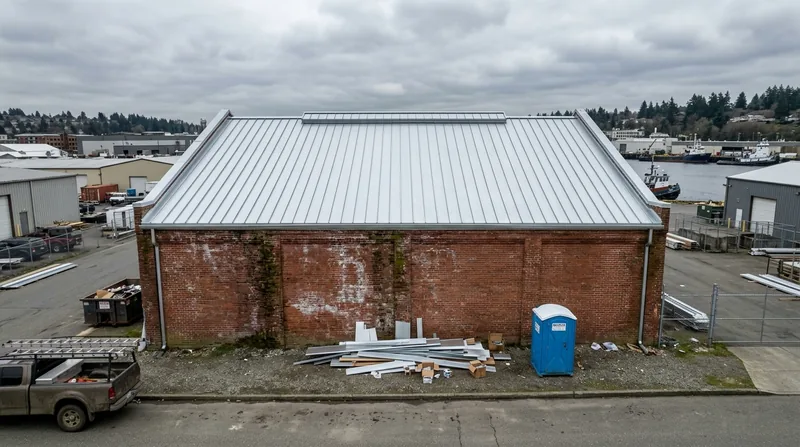




Commercial & Agricultural Metal Roofing in Seattle: Built for Warehouses, Workshops, and Barns
Seattle's commercial and agricultural buildings sit in two very different worlds. In Georgetown, SoDo, and along Ballard's industrial waterfront, you have warehouses, workshops, churches, and light commercial buildings with low-slope and pitched roofs that take a beating from steady rain and atmospheric-river storms. Out in the Snoqualmie Valley, barns, shops, and outbuildings face the same wet winters plus occasional snow and wind that peels back cheap panels. Commercial & Agricultural Metal Roofing in Seattle means panel systems sized for long runs, walkable loads, and drainage that actually handles our rainfall. We install, repair, and replace these roofs with materials chosen for the building, not a catalog default. Start with a look at our metal roof installation process if you want the full picture.
Why Commercial and Agricultural Roofs Fail Differently Around Puget Sound
On a house, a leak is an inconvenience. On a warehouse in SoDo or a barn in the Snoqualmie Valley, a leak shuts down storage, ruins equipment, and rots structural purlins fast. Our long gray damp winters keep roof surfaces wet for months, and moss and algae colonize every shaded panel. Pacific windstorms drive rain sideways under fasteners and through old sealant, and occasional snow loads test panel spans that were never engineered for it.
- Exposed-fastener panels lose their neoprene washers after 15 to 20 years, and that is the number one source of leaks we find.
- Low-slope commercial roofs pond water at seams and around penetrations when gutters and downspouts clog with fir needles and maple debris.
- Barns and outbuildings often have undersized purlins and no vapor barrier, so condensation drips from the underside all winter.
- Churches and older light commercial buildings in Ballard and Georgetown mix metal with masonry parapets, and flashing failures at those transitions cause hidden rot.
We scope every commercial and agricultural roof around the failure mode that actually dominates here: water sitting on and around fasteners, seams, and penetrations through months of rain.
Key info: A Georgetown warehouse we inspected had three active leaks, all traced to washer failure on a 1990s screw-down panel and one failed curb flashing, not to the panels themselves. Re-fastening and new flashing saved the owner a full replacement.
Roofing permits are commonly required for commercial re-roofs and replacements, and thresholds, fees, and inspection requirements vary by jurisdiction. Always confirm details with the local building department, and check the Seattle Department of Construction and Inspections for current rules.
How We Approach a Commercial or Agricultural Metal Roof in Seattle
We start by measuring the actual roof, not the plans. Long panel runs on a warehouse in SoDo need different structural attachment than a 40-foot barn roof in the valley, and both need drainage that moves our rainfall away from the building. We check purlin spacing, deck condition, and existing insulation before we quote a panel profile or gauge.
- We walk the roof and document every penetration, seam, fastener, and flashing detail with photos.
- We check structural attachment and purlin spacing so the panel system matches the building, not the other way around.
- We recommend a panel profile and gauge based on span, slope, and traffic (walkable roofs get heavier gauge).
- We remove and dispose of the old roofing, or plan a retrofit where code allows it over existing layers.
- We install new underlayment, insulation, and panels, and we seal every curb, vent, and wall transition.
- We test drainage and walk the roof with you before we call the job complete.
For exposed-fastener systems, our corrugated and ribbed panel roofing page covers the profiles we use most on shops and barns.
Key info: A church in Ballard needed a new roof but could not close for weeks. We phased the work over two long weekends, kept the sanctuary dry with temporary weatherproofing, and finished the standing seam sections between services.
Approaches We Use for Commercial and Agricultural Metal Roofs
Not every building gets the same system. A warehouse in Kent with a low slope and heavy foot traffic needs a different answer than a hay barn in the Snoqualmie Valley. Here is how we match the approach to the building.
| Approach | Description | Best for |
|---|---|---|
| Standing seam panels | Concealed fasteners, raised seams, long panel runs with fewer penetrations. | Warehouses, churches, and light commercial buildings where leaks at fasteners are the main risk. |
| Exposed-fastener ribbed panels | Screw-down panels with exposed washers, fast to install and easy to repair. | Barns, workshops, and outbuildings where budget and repairability matter most. |
| Insulated panel systems | Metal panels bonded to foam insulation for thermal control and condensation management. | Heated shops, commercial buildings, and barns that need to stop underside condensation. |
| Retrofit over existing roof | New metal panels installed over the existing roof where code allows a set number of layers. | Commercial buildings where tear-off cost and downtime are the deciding factors. |
| Repair and re-fastening | Replacing failed screws and washers, resealing seams, and fixing flashing at curbs and walls. | Older roofs with good panels but failing fasteners or penetrations. |
We pick the approach after we see the roof, the structure, and how the building is used, because the cheapest panel is rarely the cheapest roof over 30 years.
Commercial & Agricultural Metal Roofing Cost in Seattle: What to Expect
Every commercial and agricultural roof starts with a free estimate, and that is the only number that means anything because the range is wide. A small workshop re-roof and a 20,000-square-foot warehouse are not the same job, and neither are a valley barn and a Georgetown church with parapet flashing. Factors that move the price include roof size and slope, panel profile and gauge, insulation and condensation control, the number of penetrations and curbs, tear-off versus retrofit, and access (crane, lift, or ladder).
Getting two or three estimates is smart on any commercial roof. It keeps the scope honest, exposes contractors who quote a panel without checking purlins, and gives you a basis to compare warranties and fastener specs. Our full pricing overview breaks down how we build a number.
Commercial & Agricultural Metal Roofing Near Me: How to Choose a Contractor Near Seattle
Hiring for a commercial or agricultural roof is a bigger decision than a house re-roof, so treat the vetting seriously. You want a contractor who is licensed and insured in Washington, carries workers' comp, and can show you commercial and agricultural references, not just residential ones. Ask how they handle permits, because re-roofs and replacements commonly require them and the rules vary by jurisdiction. If the building is in a historic district or under HOA design review, panel profile and color may be restricted.
- Verify the license and insurance, and ask for a certificate before work starts.
- Get two or three written estimates with the same scope so you can compare fairly.
- Ask for references on similar buildings (warehouse, church, barn) and call them.
- Confirm who pulls the permit and who handles inspection.
- Read the warranty on panels, fasteners, and workmanship before you sign.
If a contractor will not put the scope and warranty in writing, keep looking. Reach us through our contact and free estimate page when you are ready to compare.
Commercial & Agricultural Metal Roofing in Seattle: Pricing Guide
| Service | Price | Details |
|---|---|---|
| Commercial re-roof or replacement | Free estimate | On-site measurement, panel and gauge recommendation, and a written scope before any number is quoted. |
| Agricultural barn or outbuilding roof | Starting at $4,500 | Typical small barn or shop roof with exposed-fastener panels, includes tear-off and basic trim. |
| Repair and re-fastening | Starting at $850 | Replacing failed screws and washers, resealing seams, and fixing minor flashing leaks. |
| Large warehouse or multi-building job | On estimate | Needs an on-site look at structure, access, phasing, and insulation before pricing. |
| Travel | Included | in Seattle and surrounding areas, no separate call-out or mileage fee. |
| Estimate | Free | Response within 24h at (425) 648-6332, no obligation to book. |
Indicative pricing, the exact cost depends on square footage, finish, and site access. Free personalized estimate within 24h at (425) 648-6332.


