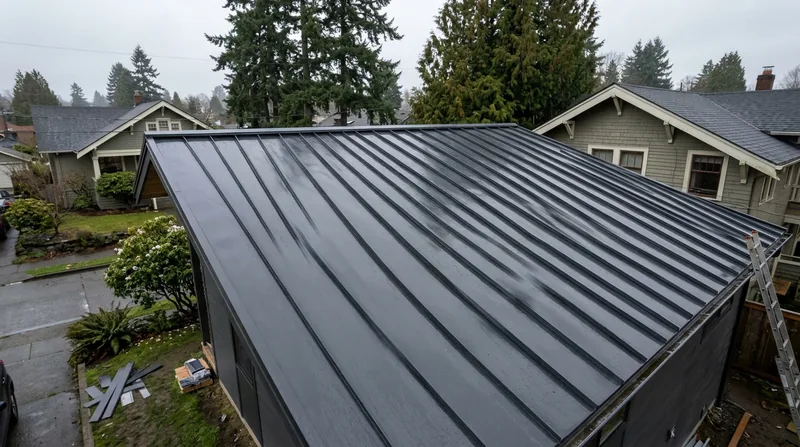




Standing Seam Metal Roofing in Seattle: Built for Rain, Moss, and Douglas Fir Needles
If you own a home between Puget Sound and Lake Washington, you already know what a roof faces here: months of steady rain, atmospheric-river storms, moss that creeps across every shaded plane, and Douglas fir needles that pile up in valleys and gutters. Standing Seam Metal Roofing in Seattle answers all of that with concealed fasteners, roll-formed panels cut to length, and a smooth surface that sheds water and debris instead of holding it. We install mechanically seamed and snap-locked systems on Craftsman bungalows in Ballard, brick Tudors in Mount Baker, Queen Anne Victorians, and the boxy infill townhomes going up across West Seattle. No exposed screws means nothing to back out and leak in nonstop rain. If you are still weighing options, start with our metal roof installation overview, then come back here for the standing seam specifics.
Why Concealed-Fastener Panels Make Sense on Seattle's Steep, Tree-Shaded Lots
The dominant failure mode on Puget Sound roofs is not sun or hail. It is water sitting where it should not, and fasteners working loose under constant wet-dry cycling. Exposed-screw panels depend on a rubber washer at every penetration, and those washers age out. Standing seam eliminates the problem at the source: the panel floats over the structure and the seam locks the water out. Add the moss and algae pressure from tall cedars and maples shading north slopes, and a smooth metal plane that dries fast and rinses clean starts to look less like a luxury and more like maintenance relief.
- No exposed fasteners means no washer failures and no screw-back-out leaks in year ten of steady rain.
- The panels shed fir needles and leaves instead of trapping them like asphalt shingle granules do.
- Roll-formed panels run the full slope length, so fewer end laps mean fewer places for water to find a way in.
- The finish resists moss and algae growth on shaded north-facing planes under cedar canopy.
- Panels handle windstorm uplift better than shingles when Pacific systems come through the Sound.
For hillside homes in Queen Anne and Magnolia, that combination of wind resistance and clean water shedding is the whole argument.
Key info: On a 1920s Ballard bungalow with two large maples over the north slope, we replaced a moss-choked shingle roof with a snap-lock standing seam system in a dark bronze finish. Two winters later the homeowner reports no needle buildup in the valleys and no recurring moss treatment.
Permits for a full re-roof vary by jurisdiction, so always confirm the current requirements with the Seattle Department of Construction and Inspections before work begins: Seattle Department of Construction and Inspections.
How We Install Standing Seam on Seattle Homes, From Tear-Off to Final Seam
Every job starts with a deck inspection, because a 100-year-old Ravenna foursquare and a 2015 infill townhome in West Seattle fail in different ways. We strip the old roof, check sheathing for soft spots and rot, and correct anything the next layer would hide. Then we set underlayment rated for our rain load, roll-form the panels on site to the exact slope length, and mechanically seam or snap-lock every rib. Flashing at chimneys, valleys, and skylights gets the same attention, since that is where most leaks begin.
- We inspect the deck and framing and replace any rotten sheathing before a single panel goes up.
- We install high-temp underlayment and ice-and-water shield in the valleys and at penetrations.
- We roll-form panels to length on site, which means no lap joints on long slopes.
- We fasten with concealed clips that let the panel move with temperature swings.
- We mechanically seam or snap-lock each rib and seal the closures at ridge and eave.
- We walk the roof with you at the end and hand over the manufacturer warranty paperwork.
That sequence is the same on a Lake Washington waterfront home and a Lake City rambler, though the details change with slope and exposure.
Key info: A split-level in Lake City had a low-slope rear section that had leaked for years under shingles. We ran standing seam panels down the full slope with concealed clips and a proper transition flashing, and the rear room has stayed dry through two atmospheric-river seasons.
For homes in the 98101 core and nearby, see our Seattle 98101 standing seam page for neighborhood-specific notes.
Panel Systems We Install and Where Each One Fits
Not every Seattle roof wants the same profile. A Tudor in Mount Baker reads differently from a modern boxy contemporary on a West Seattle view lot, and the seam style should match the architecture. Here is how the main approaches compare for local homes.
| Approach | Description | Best for |
|---|---|---|
| Mechanically seamed | Double-locked seam folded with a power seamer, the tightest water barrier available | Low-slope sections, high-wind exposures, waterfront homes |
| Snap-lock | Concealed clip system with a friction-fit seam, faster to install | Standard residential pitches on Craftsman and Tudor homes |
| Trapezoidal rib | Taller, bolder ribs with a more industrial profile | Modern infill, contemporary homes, detached garages |
| Narrow-seam profile | Tighter seam spacing for a finer, more traditional look | Historic-district homes and Victorian rooflines on Queen Anne |
| Retrofit over existing shingles | Panels set on battens over the old roof where code allows the layer count | Homes where tear-off access or disposal cost is a concern |
We match the profile to the house, the pitch, and the wind exposure, not to whatever is easiest to stock.
Standing Seam Metal Roofing Cost in Seattle: What to Expect
Homeowners ask for a number first, and the honest answer is that standing seam starts around From $10/sq ft installed and climbs from there. Panel width, seam type, gauge, finish, and roof complexity all move the figure. So does access: a steep Queen Anne Victorian with a detached garage and tight alley is a different job from a simple gable rambler in Shoreline. Tear-off, deck repair, and flashing work add to the total when the existing roof is layered or the sheathing is soft.
We give you a written scope with the panel system and finish spelled out, so you can compare bids line by line. Getting two or three estimates is smart, and we would rather you do it than sign the first number you hear. Our full pricing overview breaks down the ranges by system and roof type.
What to Look for When Hiring a Metal Roofing Contractor Near Seattle
Metal roofing is a specialty, and a crew that mostly installs asphalt can get standing seam wrong in ways you will not see for years. Check that the contractor is licensed and insured in Washington and can show a certificate of insurance on request. Ask for local references on standing seam jobs, not just metal in general. Confirm who pulls the roofing permit and who handles inspection. And if your home sits in a historic district or an HOA with design review, verify the panel profile and color are approved before anyone orders material.
We have been installing metal roofs here since 2009 and are a Metal Roofing Alliance Member. You can request a free estimate and we will walk the roof with you, answer the hard questions, and put the scope in writing.
Standing Seam Metal Roofing in Seattle: Pricing Guide
| Service | Price | Details |
|---|---|---|
| Standing seam, standard residential pitch | Starting at $10/sq ft | Includes tear-off, underlayment, panels, and basic flashing; pitch and access move the price |
| Mechanically seamed, low-slope or high-wind exposure | Starting at $13/sq ft | Power-seamed double lock, heavier clips, and wind-rated attachment for waterfront and exposed lots |
| Retrofit over existing shingles | On estimate | Battens, layer count, and deck condition must be verified on site before a number is given |
| Complex roof with valleys, dormers, or multiple planes | On estimate | Cut-up geometry, custom flashing, and steep access need an on-site look first |
| Travel | Included | In Seattle and surrounding areas, no separate call-out or mileage fee |
| Estimate | Free | Response within 24h at (425) 648-6332, no obligation to book |
Indicative pricing, the exact cost depends on square footage, finish, and site access. Free personalized estimate within 24h at (425) 648-6332.


